Pavement Stabilization of E10, E14 & N16 Roads in Amaravati, Andhra Pradesh

Amaravati, Andhra Pradesh, India |  Amaravati Development Corporation Ltd. (ADCL)

Overview

Amaravati, the new capital city for the state of Andhra Pradesh is envisioned to be not only as a government administrative city but also as an economic hub. The vision is to develop Amaravati as the global economic hub and emerge as global destination of people, investments, jobs endowed with world’s best infrastructure. The road network of the capital city has been planned in line with the vision and objectives of the new capital city.

There are major challenges to achieve the objectives as the entire city of Amaravati is to be developed on the agricultural fields which contain black cotton soils having more than 200% swelling index. So, the government is taking all necessary measures to adopt the global technology to strengthen the road network and make the road infrastructure more durable.

Challenge

Soil reports show that the subgrade soil present in the project site is mostly clay with high plasticity having soaked CBR of 2 and swelling index in the range of 200%. These soils are potentially expansive soils, such as, black cotton soils and montmorillonite clays. When these soils subjected to changes in moisture content due to seasonal wetting and drying or due to any other reason undergo volumetric changes leading to pavement distortion, cracking and general unevenness. In semi-arid climatic conditions, pronounced short wet and long dry conditions occur, which aggravate the problem of swelling and shrinkage.

Solution

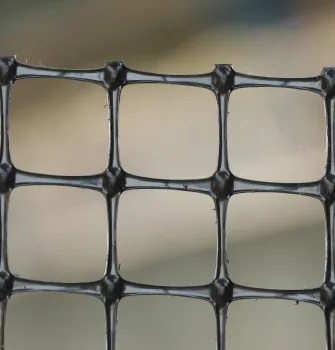
After a careful evaluation of the project requirements and site conditions, it was decided to reinforce the pavement section with Techgrid PP biaxial 30/30 Geogrid + Techgeo PN25 Non-Woven Geotextile at the subgrade level.

Following outcomes are desired by introducing Techgrid PP biaxial Geogrid and Techgeo NonWoven Geotextile:

 Techgrid PP Biaxial reinforcement helps in preventing the development of longitudinal cracks, whereas the section with no geogrid develops cracks within a few months of construction due to the subgrade soil properties.

 Researches and Previous case histories have shown that the junction efficiency (i.e. within the bonded portion of the longitudinal and transverse ribs) plays a major role in the performance of the geogrid. In comparison the polyester geogrid failed and the polypropylene grid performed well, as junction efficiency of the PP Biaxial Geogrid is higher than other types of Geogrids.

 PP Biaxial Geogrid has apertures of sufficient size to allow interlocking with surrounding aggregate materials. Biaxial geogrid increases the stiffness of unbound aggregate base layers and confines the aggregate particles under repetitive loading.

 PP Biaxial Extruded geogrid shall reinforce the granular layer and basic mechanism of reinforcing can be identified as (a) lateral restraint (confinement of granular material in grid), (b) improved bearing capacity, and (c) tensioned membrane effect. Biaxial geogrids must be punched and drawn polypropylene material.

Specific to the roads developed in the Amaravati capital region of Andhra Pradesh, the subgrade soil is purely black cotton with high free swell index, wherein the current solution to counter the effect of free swell index proposed is to prepare a subgrade of 0.5m with sand before laying the pavement layers (Base and Sub base).

In this scenario addition of PP biaxial geogrid will further improve the elastic modulus of the prepared subgrade by the mechanism of lateral restraint and tension membrane effect. This improvement in elastic modulus will minimize the strains developed due to high expansiveness of existing subgrade.

The soil thrust developed on the prepared subgrade due to high swelling of existing subgrade will be laterally transferred by the geogrid, thus nullifying the effect at the subgrade level itself. With the incorporation of PP biaxial geogrid, the loads from the superstructure are dispersed into the wider area. This reduces the load intensity on the existing subgrade. Considering the effect of shallow ground water table, a non-woven geotextile layer is provided below the geogrid.

The function of Non-Woven geotextile is to act as separation layer between the subgrade layer and the granular base and sub base layers. The separation function refers prevention of intermixing of the two layers of dissimilar materials throughout the design life of the material. Normally, geotextiles provide for separation between layers in pavement. It prevents intrusion/pumping of soil particles into the base/sub-base course. Simultaneously, it performs the function of filtration by dissipating the pore water pressure and allowing the passage of fluids into or across the plane of the geotextiles while preventing the uncontrolled passage of soil particles.

Project Outcome & Performance

Techfab India has supplied the entire quantity of Techgrid Geogrid within the stipulated time and meeting all the quality requirements. The granular layers of the pavement have been completed by the contractor with full satisfaction of the Amaravati Development Corporation and Project Management Consultants. Bituminous layers are to be laid further.