

Home / Success Stories / Valley-Side Road Retention Works using TechFab Gabion Fascia Reinforced Soil Wall on Pathankot to Mandi Highway (NH-154), Himachal Pradesh
Himachal Pradesh, India | National Highways Authority of India (NHAI)
The Ministry of Road Transport & Highways (MoRTH), Government of India, undertook the construction of a four-lane highway to enhance connectivity between Pathankot (Punjab) and Mandi (Himachal Pradesh). The project was aimed at reducing the existing travel distance from 219 km to 171 km, thereby improving travel efficiency along this strategically important corridor connecting Pathankot to Leh, Ladakh, and other forward areas of North India.
The overall highway development was divided into five packages, of which Package 2A was covering an 18.45 km stretch from Sihuni (Siyuhni) to Rajol. The scope of work under this package was involving the rehabilitation and upgradation of the existing two-lane highway to a four-lane configuration, along with strengthening of the Sihuni – Rajol section from Km 51.000 to Km 72.000 of NH-20 (new NH-154). The project was being executed under the Hybrid Annuity Mode (HAM).
A key engineering challenge within this package was involving valley-side road retention over a 1.1 km stretch, which was required to accommodate the proposed 22 m wide roadway in hilly terrain. Appropriate design and construction solutions were being implemented to ensure structural stability, safety, and long-term performance while addressing constraints such as steep slopes, difficult geology, and limited right-of-way.
The project corridor passes through a structurally complex Himalayan terrain, characterized by thrusts, folds, and prominent lineaments that have resulted in the formation of deep valleys and synclinal basins. These geological conditions, combined with steep slopes and highly weathered rock masses, render the region particularly vulnerable to slope instability and landslides, many of which have been historically documented along the Pathankot – Mandi highway. The susceptibility is further aggravated during periods of intense monsoon rainfall and potential seismic activity, as the project area lies within Seismic Zone V.
Soil conditions along the alignment posed additional challenges. Hill slopes were generally covered with thin, heterogeneous colluvial deposits, while valley fills and river terraces comprised unconsolidated alluvial sequences, significantly influencing foundation stability and groundwater behaviour. These varying subsurface conditions demanded careful evaluation during design and construction.
The proposed road alignment between Sihuni and Rajol traversed rugged hilly terrain with a substantial elevation difference between the carriageway and the adjacent valley. Due to Right of Way (ROW) constraints, adopting a conventional 2(H):1(V) cut slope was not feasible. The restricted corridor eliminated the option of traditional cut-and-fill methods, while the naturally steep slopes increased the risk of erosion and instability. Consequently, engineered valley-side retention solutions were essential to safely accommodate the design road width, ensure long-term stability, and minimize environmental impact.
Sustainable and cost-effective geotechnical solutions have significantly increased the adoption of Reinforced Soil (RS) Walls for road retention, particularly in challenging hilly terrain. Owing to their flexibility, ease of construction, seismic efficiency, and ability to utilize locally available fill materials, RS walls were selected as the most suitable retention system for the project. The solution effectively integrates modern geotechnical engineering principles with environmental considerations, addressing challenges related to steep gradients, unstable slopes, and severe space constraints.
Based on detailed assessment of site conditions and terrain constraints, a gabion fascia RS wall system with varying heights ranging from 4.8 m to 20.8 m was proposed. The design was carried out in accordance with IRC:SP:102 for both static and seismic loading conditions, ensuring compliance with applicable Indian standards. To minimize excavation on the hillside and to safely accommodate the proposed 22-m-wide roadway, a combination of full-height RS walls with positive connections and partial-height RS walls with positive connections was adopted for different project stretches.
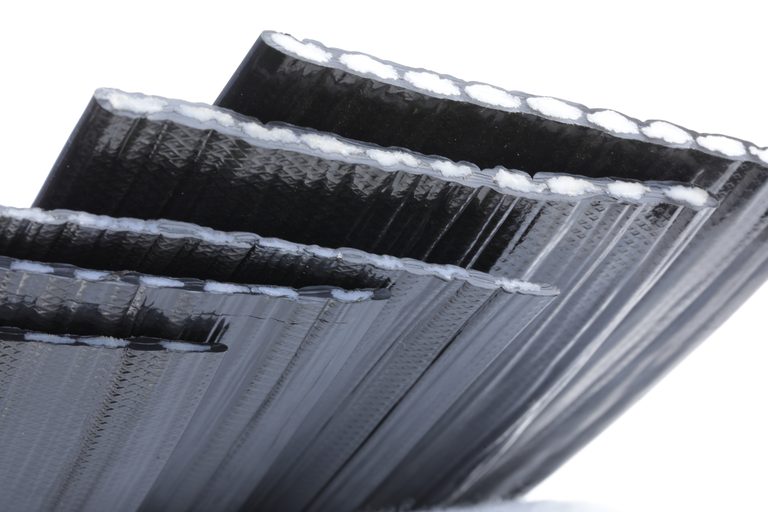
The RS wall system comprised layers of compacted structural fill reinforced with polymeric straps mechanically connected to the gabion fascia. The reinforcement material used was TechStrap (TS) – uniaxial polymeric (polyester) straps with a protective polymeric coating – engineered for demanding soil reinforcement applications. For the maximum wall height of 20.8 m, TechStrap lengths varied between 13.5 m and 17.0 m, ensuring adequate internal and external stability. The use of free-draining structural fill, which could be sourced locally and met minimum gradation and strength requirements, was recommended to prevent long-term drainage issues such as clogging of geotextiles or gabion voids.
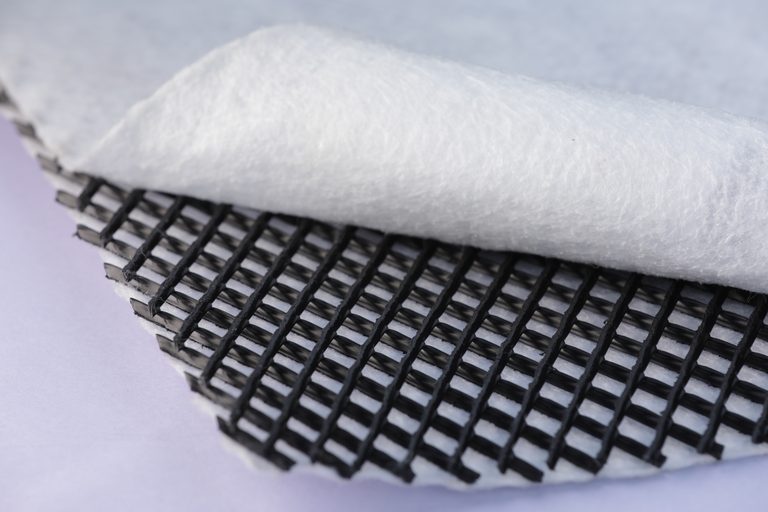
A non-woven geotextile was provided as a separator and filter to restrict migration of fine particles from the structural fill into the stone-filled gabion fascia. Additionally, a drainage composite system, consisting of a thermally bonded inner drainage core with geotextile filters on both sides, was installed behind the RS wall to intercept and collect subsurface seepage from the slope. The collected water was conveyed through a network of transverse and longitudinal perforated pipes and safely discharged into toe drains, ensuring effective seepage control.
The gabion fascia was constructed using double-twisted hexagonal steel wire mesh (10 × 12 mm grid) made from 2.7/3.7 mm diameter wires, coated with zinc and polymer (PVC) to provide enhanced corrosion resistance and durability under harsh environmental conditions.
The RS wall system was designed to withstand anticipated traffic loads and seismic forces, providing uniform stress distribution at the foundation level and ensuring long-term stability. The flexible and monolithic behaviour of the RS wall allows it to accommodate differential settlements without distress. Overall, the selected RS wall with gabion fascia proved to be a seismic-resilient, cost-effective, and environmentally compatible solution, offering significant advantages over conventional rigid retaining structures in steep and restricted corridors.
The Reinforced Soil (RS) Wall has been successfully constructed at some stretches, while construction is still ongoing at others. Even after being subjected to two monsoon cycles, the completed RS wall sections continue to perform effectively, demonstrating their reliability under challenging climatic conditions. This performance validates the robustness of the design, quality of construction, and the suitability of the products and overall solution for the prevailing terrain and site conditions. The stable behavior of the constructed sections has ensured the safety of the road embankment, protected the infrastructure, and resulted in a high level of client satisfaction with the adopted RS wall system.