Geocomposite Drain Behind Abutments & Wing Walls of Bridges, Rewari–Dadri Section (CTP-14), WDFC Phase II, Haryana

Haryana, India | Dedicated Freight Corridor Corporation of India Ltd (DFCCIL)

Overview

Phase-II of the Western Dedicated Freight Corridor comprises 550 km of double-line electrified track with a 2×25 kV AC, 50 Hz overhead catenary system, spanning two sections — the Southern Section from Jawaharlal Nehru Port (JNPT) to Vadodara (422 km) and the Northern Section from Rewari to Dadri (128 km). The work covered the Rewari–Dadri stretch (128 km) through Rewari, Alwar, Mewat, Gurgaon, Palwal and Faridabad–Greater Noida in Haryana, Rajasthan and Uttar Pradesh — an entirely greenfield, detour alignment. This Design and Build Integrated Package involved construction of civil works (embankments, structures, tunnels), tracks, major and minor bridges, and traction substations. L&T Construction won the project from the Dedicated Freight Corridor Corporation of India Ltd. (DFCCIL) and adopted innovative construction methods to reduce the construction duration.

Challenge

Providing a proper drainage system behind the retaining structure is critical, as inadequate drainage allows pore water pressure to build up, which can damage or cause failure of the retaining structure — making a well-designed drainage arrangement essential. Conventional drainage systems require large quantities of granular material, which was scarce and available only at high cost in this project region. Installing conventional drainage also demands considerable skill and is time-consuming.

Solution

L&T Construction approached TechFab India for an alternative drainage solution. TechFab India suggested TFI Drainage Geocomposite — TechDrain — developed to meet the drainage requirements specified by government authorities such as MoRTH, IRC and RDSO. As this was a railway project, the product specification conformed to RDSO Guidelines (Specification No. RDSO/2018/GE:IRS-0006).

For approval, third-party testing was carried out at an independent laboratory for all requisite parameters, and the results were satisfactory as per the RDSO standard specification. DFCCIL granted approval after all pre-requisites as per RDSO standard requirements were met.

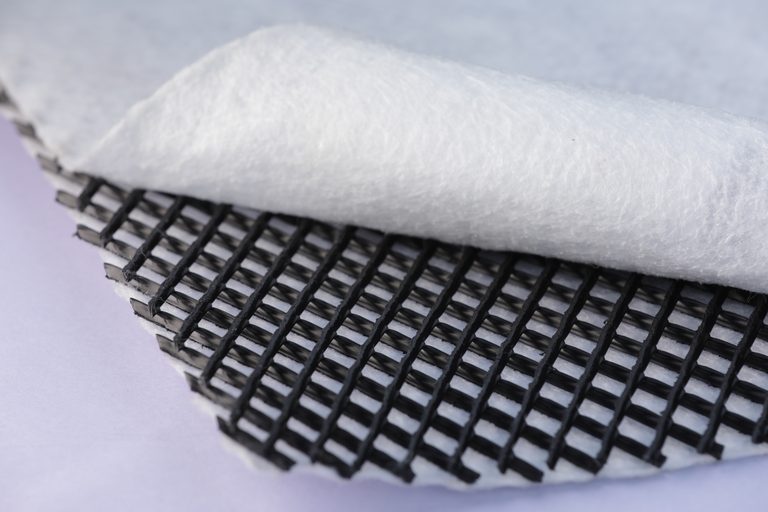
TechDrain Drainage Composite is formed by combining nonwoven geotextile — acting as a filter and separator on one or both sides — with a geonet core. It reduces pore water pressure and thereby increases the overall stability of earth-retaining structures. Its multi-directional flow design provides a continuous path for water discharge, eliminating the potential for hydrostatic pressure build-up, and allows water to pass freely into the drainage core, where it is gravity-fed into the main drainage collection system.

The Drainage Geocomposite was laid behind the wall facia, with its bottom end connected to a perforated PVC pipe (optional) of suitable diameter to drain the water off.

Project Outcome & Performance

The TechDrain Drainage Composite installation along the Rewari–Dadri section met all RDSO testing and approval requirements from DFCCIL, providing effective, low-maintenance drainage behind the abutments, wing walls and earth-retaining structures across this greenfield stretch of the Western Dedicated Freight Corridor.

Related Sectors
Related Solutions

Frequently Asked Questions
(FAQs)

The Geocomposite Drain is installed behind abutments, wing walls, and earth retaining structures to prevent pore water pressure build-up. It ensures proper drainage, thereby enhancing the stability and durability of bridge and retaining structures.

Scarcity and high cost of granular materials in the project region.

Conventional systems are labor-intensive and time-consuming.

TechDrain offers a cost-effective, easy-to-install, and high-performance alternative that meets MoRTH, IRC, and RDSO specifications.

Nonwoven geotextile layers act as filters and separators, preventing soil particles from clogging.

The geonet core provides multi-directional water flow, reducing hydrostatic pressure.

Water is discharged into the main drainage system, optionally connected to perforated PVC pipes.

Yes. TechDrain was tested at a third-party laboratory for all parameters as per RDSO Specification No: RDSO/2018/GE:IRS-0006. Results were satisfactory, and DFCCIL granted approval after compliance with RDSO standards.

Efficient drainage performance behind retaining structures.

Reduced construction time and cost compared to conventional methods.

Durable and reliable under varying loads and environmental conditions.

Environmentally sustainable solution minimizing aggregate usage.

TechDrain was laid behind the abutments, wing walls, and earth retaining structures along the Rewari–Dadri section (128 km) of the corridor in Haryana, India.

Scarcity of granular materials in the project area.

High cost and time requirements of conventional drainage systems.

Need for a railway-approved, high-performance drainage solution.