Ground Improvement using TGC Reinforced Nonwoven for Container Yard and Storage Ware House at Dondo Logistics Terminal near Beira Port, Mozambique

Dondo, Mozambique, Africa |  

Overview

The development of the Dondo Logistics Terminal near Beira Port, Mozambique, is a strategic infrastructure initiative aimed at easing congestion at one of Southern Africa’s most critical trade gateways. Beira Port serves as a vital logistics hub within the Beira Corridor, supporting landlocked countries such as Zimbabwe, Zambia, Malawi, and the Democratic Republic of Congo. Increasing cargo volumes, however, have placed significant pressure on port operations, resulting in congestion, delays, and inefficiencies in cargo handling and transportation.

Challenge

As part of this expansion, the construction of a container yard and storage warehouse required careful consideration of challenging geotechnical conditions at the project site. The subsoil profile consisted of soft clay strata, loose reclamation sand, and high groundwater levels, all of which posed risks of excessive settlement, low bearing capacity, and potential surface instability under heavy container loads. Conventional ground improvement techniques were deemed inadequate due to the magnitude of loading and long-term performance requirements. Additionally, the coastal environment and continuous operational demands required a durable and reliable solution to ensure structural integrity, minimize maintenance, and support heavy repetitive loading from container stacking and vehicular movement.

Solution

To overcome the geotechnical challenges, TechFab India suggested the use of an engineered ground improvement solution incorporating geosynthetic technology for the container yard and warehouse foundation. The system utilized TechFab’s TGC Reinforced Nonwoven Geotextile (TGC 105 x 105 with 150 GSM nonwoven), designed to provide both reinforcement and separation functions.

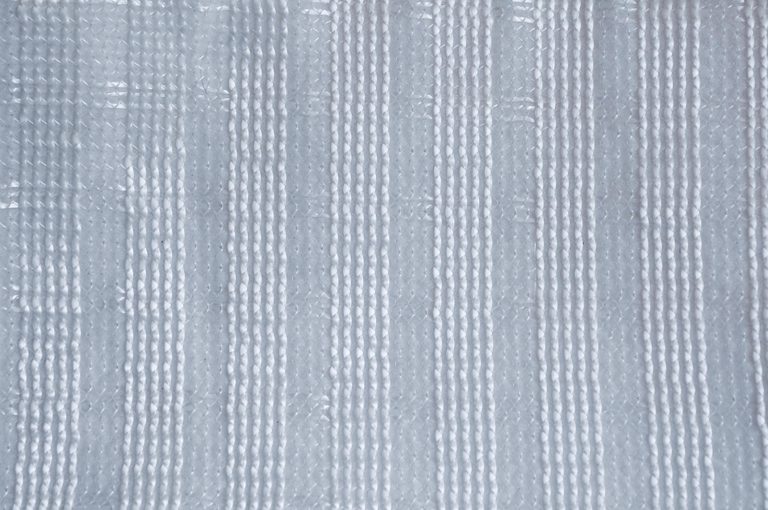
TechFab TGC is a knitted nonwoven composite comprising a nonwoven geotextile reinforced with high tenacity polyester yarns in both machine and cross-machine directions. These high tenacity, high molecular weight, low CEG polyester yarns offer high tensile strength with low creep, enabling efficient reinforcement of weak subgrades. The 150 GSM nonwoven component performs the essential functions of separation, filtration, and drainage. Additionally, the product is resistant to chemical and biological environments typically found in soils and is stable against short-term ultraviolet exposure, ensuring durability in coastal conditions.

The high-strength geogrid component improved load distribution, thereby enhancing the bearing capacity of the weak subgrade. Simultaneously, the nonwoven layer prevented intermixing of the subgrade and granular layers while facilitating drainage under high groundwater conditions.

This integrated system significantly reduced differential settlement and improved the overall stability of the container yard surface. The geosynthetic layer enabled efficient stress transfer across the subgrade, allowing for optimized thickness of the granular layers and reducing the need for excessive fill material. The solution ensured faster construction due to ease of installation and reduced material requirements, making it both time-efficient and cost-effective. Importantly, it provided long-term durability to withstand heavy container handling equipment and continuous truck traffic, ensuring sustained performance with minimal maintenance.

Project Outcome & Performance

The use of TGC Reinforced Nonwoven Geotextile provided an effective and sustainable ground improvement solution for the Beira Port container yard project. It successfully addressed weak soil conditions, reduced settlement risks, and enhanced load-bearing capacity. The solution improved construction efficiency and ensured long-term performance under heavy operational loads. This project highlights the critical role of geosynthetics in developing resilient infrastructure in challenging coastal and soft soil environments.