Pavement Stabilization using TechCell Geocell at Kecheri Bypass on the Thrissur - Kuttippuram State Highway, Kerala

Thrissur, Kerala, India |  PWD Kerala

Overview

The Kecheri Bypass is a crucial 10-km stretch of road on the Thrissur – Kuttippuram State Highway, connecting local and intercity traffic. However, a specific 1.2-km section of this bypass, passing through the middle of a field, has been plagued by persistent issues of soil subsidence during the monsoon.

Challenge

The region’s weak subsoil and heavy rainfall lead to severe waterlogging, undermining the road’s foundation. The combination of unstable ground conditions and inadequate drainage has caused recurring road collapses, rendering the section impassable during the rainy season. These disruptions not only affect traffic flow but also hinder regional connectivity, posing challenges for commuters and the transportation of goods. Traditional road construction techniques have failed to address these recurring issues due to the complex geotechnical conditions. To overcome this, the Kerala Public Works Department (PWD) initiated a pioneering project aimed at providing a durable, cost-effective solution that ensures uninterrupted connectivity and reduces long-term maintenance needs, setting a benchmark for road construction in challenging terrains.

Solution

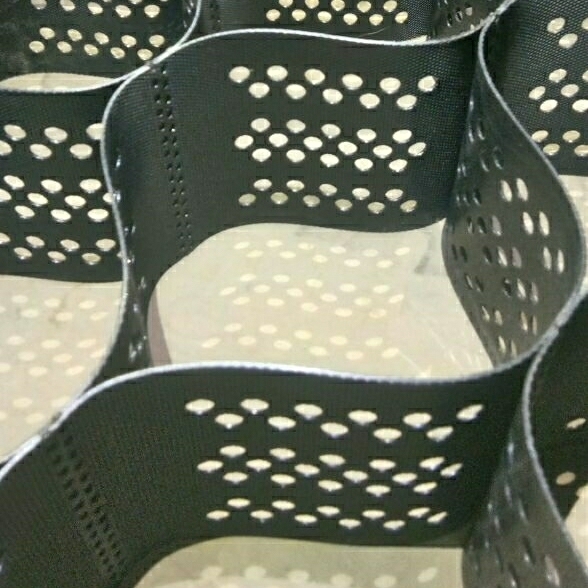
TechFab India proposed an innovative geosynthetic solution – TechCell Geocell for road construction on the Kecheri Bypass on the Thrissur – Kuttippuram State Highway, where geocells were used for the first time in the state. The solution involved the installation of Techcell Geocells, which were filled with a mixture of metal and M-sand (Wetmix Macadam) to provide stability and support. This technique was particularly beneficial for areas with challenging conditions, such as coastal roads and roads prone to permanent waterlogging.

TechFab India’s approach used nonwoven geotextile as a base layer beneath the geocell structure. The nonwoven geotextile acted as a separation and filtration layer, preventing the mixing of subgrade soil with the aggregate fill material. This ensured the longevity and durability of the road while maintaining its strength and load-bearing capacity.

Geocells, made from high-density polyethylene (HDPE), were designed to distribute the weight of the road surface evenly, preventing rutting and deformation due to moisture infiltration and soil erosion. The honeycomb structure of the geocell offered enhanced reinforcement and improved load distribution, making it an ideal solution for areas with unstable subgrades.

The use of this technology offered several advantages, including cost-effectiveness, quicker installation, and improved road performance in the long term. With this advanced solution, TechFab India aimed to significantly reduce road maintenance issues caused by waterlogging and soil instability, making it a sustainable and reliable choice for infrastructure development in challenging environments.

Project Outcome & Performance

The project was successfully completed, achieving its intended purpose with innovative geosynthetic solutions. It ensured stability, reduced maintenance, and earned full satisfaction from the client and contractor.

Frequently Asked Questions
(FAQs)

The project aimed to stabilize a problematic 1.2-km stretch of the Kecheri Bypass that frequently collapsed during monsoons due to weak subsoil and waterlogging, ensuring uninterrupted connectivity and reducing long-term maintenance.

The bypass section passed through fields with unstable subsoil. Heavy rainfall caused severe waterlogging, undermining the road foundation and leading to repeated collapses. Traditional construction methods failed to provide a durable solution.

  • Weak and unstable subgrade soils
  • Persistent waterlogging during monsoon seasons
  • Soil subsidence and road collapses
  • Inadequate drainage leading to impassable roads
  • Disruption of traffic and regional connectivity

TechFab India introduced TechCell Geocell technology for the first time in Kerala. The geocells were filled with a mixture of metal and M-sand (Wetmix Macadam) to provide stability. A nonwoven geotextile base layer was also installed to act as a separation and filtration layer.

  • Distributes load evenly across the road surface
  • Prevents rutting and deformation caused by moisture infiltration
  • Provides lateral confinement of aggregates
  • Reduces soil erosion and subsidence
  • Offers quicker installation and cost-effectiveness compared to conventional methods
  • Acted as a separation layer, preventing mixing of subgrade soil with aggregates
  • Provided filtration, dissipating pore water pressure
  • Enhanced durability and longevity of the pavement structure

The honeycomb structure of HDPE geocells is ideal for coastal and waterlogged areas. It reinforced the weak subgrade, improved load distribution, and ensured road stability even under heavy rainfall and poor drainage conditions.

  • Road stability achieved in the problematic stretch
  • Reduced maintenance requirements
  • Improved durability and performance of the bypass
  • Full satisfaction from PWD Kerala and contractors
  • Successful demonstration of geocell technology in Kerala for the first time
  • TECHCELL Geocell
  • TECHGEO PP Nonwoven Geotextile