Home / Success Stories / Rehabilitation & Widening for 2 Lane with Paved Shoulders of Munger Sultan Ganj – Bhagalpur Section on EPC Mode in the State of Bihar
Bihar, India | National Highways Authority of India (NHAI)
The project involves rehabilitation and widening work for 2-lane/ 2- lane with paved shoulder of existing NH-80 from km 70.15 to km 121.025 of Munger-Sultanganj- Bhagalpur section in the state of Bihar under EPC (engineering, procurement and construction) mode with a budgetary estimate of ₹398.88 crores. The total length of the project was 50.875 km, located (NH-33, old NH-80) on the south bank of the river Ganga, which falls under a high flood zone. The flooding severely affects the pavement, disrupting operations between cities and cause early degradation of pavement.
The project was located in the Gangetic plain, where surrounding soil primarily consist of clay or fine silt. Moreover, the granular material needed to be transported from Jharkhand, leading to extended construction timelines and increased carbon footprint and greenhouse gas emissions. Therefore, various drainage alternatives were analysed, among which geosynthetic solutions appear to be the most promising. Hence the proposed solution should be efficient to drained water from the pavement under unsaturated condition.
Bihar is categorized as state with low mining activity areas mainly due to limited mineral reserves, regulatory constraints, and an economy focused on agriculture. The limited availability of suitable granular material for the project required the Granular Sub-Base (GSB) to be transported from distant sources. This led to increased shipping distances, higher transportation and logistical costs, and extended construction durations. As a result, the project became uneconomical and experienced schedule overruns, increasing the risk of missed contractual deadlines. Nevertheless, the contract specifications mandated a 200 mm thick GSB layer to serve as a drainage blanket within the pavement structure. In view of the escalating costs, environmental concerns associated with extensive quarrying and material transportation, and the need to adhere to project timelines, the conventional use of GSB posed significant challenges. Consequently, an alternative solution was necessary to reduce dependency on natural aggregates while ensuring adequate drainage and structural performance. The proposed approach was required to be both economically and environmentally sustainable, without compromising pavement integrity, and fully compliant with applicable Indian Standard and IRC guidelines.
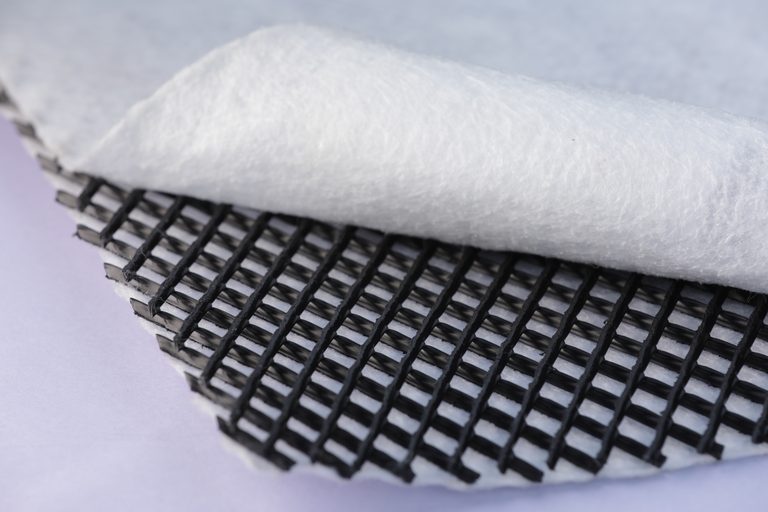
Drainage composite comprised of a drainage core material sandwiched between two layers of non-woven geotextile. The cores are two sets of parallel ribs interconnected to form rhomboidal shape.
The properties of drainage composite meet the requirement of Indian standard codes. Geotextile will act as separation, drainage and filtration layer while core material will enhance in-plane flow capacity. The crust thickness of proposed solution is as shown in table 1. To maintain continuity, the drainage composite is overlapped for 300 mm as shown in the figure 2. Thicker (200 gsm) Non-Woven geotextile was placed on top while thinner (130 gsm) Non-Woven geotextile at bottom as the top surface will be in contact with pavers, which can cause damage to geotextile. A 75 mm sand cushioning layer was recommended for additional protection against chocking of drainage composite.
Techfab India has successfully delivered the Drainage Composite within the agreed timeframe and in compliance with all quality specifications. The contractor has finished the PQC and DLC layers of the pavement to the complete satisfaction of National Highway Authority of India and the Project Management Consultants.